
What is Cold Emailing?
 Cold emailing is the practice of sending an email to someone you don’t know to introduce yourself, pitch an idea, or start a conversation. Unlike spam, which is impersonal and mass-sent, cold emails are tailored to the recipient and aim to provide value.Think of it as a digital handshake—just like introducing yourself at a networking event. The key to success lies in cold email best practices, such as personalization, relevance, and a clear call to action.For example, if you’re reaching out to a potential client, your message should highlight how your product or service can solve their specific problem. According to HubSpot, 93% of buyers prefer email communication, making cold emails an essential tool in today’s professional world.
The Importance of Effective Cold Emails in Modern Marketing and Networking
 A strong cold outreach strategy can drive sales, generate leads, and open new opportunities. Businesses use cold emails as a cost-effective way to connect with potential customers, while job seekers leverage them to reach hiring managers directly.In fact, LinkedIn research shows that 85% of jobs are filled through networking, and cold emails play a crucial role in this process.Do cold emails still work? Absolutely! Studies show that follow-up emails can increase response rates by 40% (Woodpecker). Success comes from using the right cold email best practices, such as crafting compelling subject lines, keeping messages concise, and adding value from the start.With online networking on the rise, cold emails give you a direct line to decision-makers. Whether you’re offering a service, looking for a job, or building partnerships, a well-executed cold outreach strategy can help you cut through the noise and achieve your goals.
The Fundamentals of Cold Emails
 Mastering cold email best practices is essential for crafting messages that grab attention, build trust, and drive responses.Below, we break down the key principles into actionable steps.1. Define Your PurposeEvery cold email must have a clear objective.Are you reaching out to generate leads, pitch a product, build partnerships, or land a job?A well-defined purpose ensures your message stays focused and relevant.
Key Tip: Write down your goal in one sentence before drafting the email.2. Understand Your AudienceA successful cold outreach strategy speaks directly to the recipient’s needs.Research their pain points, goals, and preferences using LinkedIn, company websites, or industry reports.
Example: If emailing a marketing manager, highlight how your solution can boost their campaign performance.3. Personalization is Non-Negotiable
Mastering cold email best practices is essential for crafting messages that grab attention, build trust, and drive responses.Below, we break down the key principles into actionable steps.1. Define Your PurposeEvery cold email must have a clear objective.Are you reaching out to generate leads, pitch a product, build partnerships, or land a job?A well-defined purpose ensures your message stays focused and relevant.
Key Tip: Write down your goal in one sentence before drafting the email.2. Understand Your AudienceA successful cold outreach strategy speaks directly to the recipient’s needs.Research their pain points, goals, and preferences using LinkedIn, company websites, or industry reports.
Example: If emailing a marketing manager, highlight how your solution can boost their campaign performance.3. Personalization is Non-Negotiable Generic emails get ignored. Personalization—such as using the recipient’s name or referencing their company—boosts engagement.According to Experian, personalized emails yield 6x higher transaction rates.Key Tip: Use specific details to show you’ve done your homework, such as mentioning a recent achievement or relevant challenge.4. Create a Captivating Subject LineYour subject line is the first thing recipients see, so make it count. A great subject line is clear, concise, and intriguing enough to make someone want to open your email.Examples of Strong Subject Lines:
- “Quick idea to boost [Recipient’s Company Name]’s ROI”
- “Loved your recent article—thoughts on [specific topic]?”
- “I saw your recent LinkedIn post about [topic], and it really resonated with me.”
- “As a fellow [industry professional], I wanted to share something that might help with [specific challenge].”
 7. Include a Clear Call to Action (CTA)A great cold email call to action is direct and specific.Avoid vague requests like “Let me know what you think.”Instead, use:
- “Can we schedule a 15-minute call next week?”
- “Would love to send over a demo. What day works best?”
Crafting the Perfect Cold Email
 Essential Components of a Cold EmailA well-crafted cold email has five key components:1. Subject LineThis is the gateway to your email. Keep it short, intriguing, and relevant. According to SuperOffice, emails with subject lines under 50 characters have a 12% higher open rate.
Examples:
Essential Components of a Cold EmailA well-crafted cold email has five key components:1. Subject LineThis is the gateway to your email. Keep it short, intriguing, and relevant. According to SuperOffice, emails with subject lines under 50 characters have a 12% higher open rate.
Examples:- “Quick idea for boosting [Recipient’s Company] ROI”
- “Loved your recent article—thoughts?”
- “Would you be open to a quick 10-minute call next week?”
- “Can I send over a brief proposal for your review?”
- Use short sentences: Long, complex sentences lose the reader. Keep it clear and concise.
- Write in an active voice: It makes your email direct and engaging. Example: “We can help boost your sales” instead of “Your sales could be boosted by us.”
- Personalize beyond names: Mention specific details like industry challenges, recent news, or shared connections.
- Time it right: HubSpot data shows emails sent on Tuesdays or Thursdays get higher engagement.
- Test and refine: A/B test subject lines, CTAs, and cold email length to find what works best.
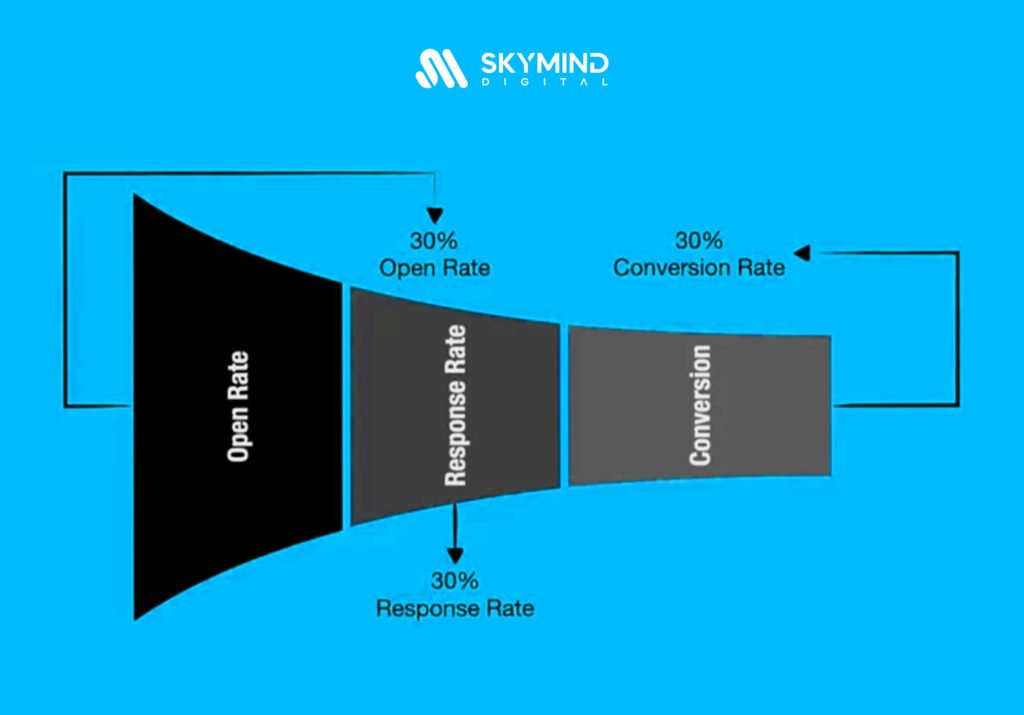 The 30-30-50 rule simplifies the process of crafting effective cold emails:
- 30% Research: Spend time understanding the recipient’s needs, challenges, and goals.
- 30% Personalization: Tailor your email based on your research to make it relevant.
- 50% Value: Focus the majority of your email on explaining how you can help them achieve their objectives.
Ideal Cold Email Length
When it comes to cold emails, less is more. Research from Boomerang suggests that emails with 50–125 words have the highest response rates, around 51%. Aim to convey your message succinctly while including the essentials.Use short paragraphs, bullet points, or bold text to highlight key points. Your email should be skimmable—busy recipients should understand your value within seconds. Remember, your goal is to spark interest, not to close the deal in one email!Building a Cold Email Strategy
 Cold Outreach StrategyA well-planned cold outreach strategy is the foundation of successful email campaigns. Start by identifying your target audience. Who are the decision-makers or professionals you need to reach?Use tools like LinkedIn or company websites to narrow your focus.Next, define your goals. Are you looking to generate leads, secure meetings, or build partnerships? Clear objectives guide your messaging and help track success.Craft compelling and personalized emails that focus on solving the recipient’s problems.A report by HubSpot shows that personalized subject lines boost open rates by 50%.Use this to your advantage by tailoring each email to the recipient’s needs.Finally, track and analyze your performance. Tools like HubSpot, Mailshake, or Yesware can help you monitor open rates, click-through rates, and replies. Use this data to tweak your strategy over time.Cold Email Sequences
 Creating an effective cold email sequence is key to building connections. Many recipients don’t respond to the first email—this is where follow-ups come in.
- Start with an engaging introduction: The first email should introduce yourself and highlight the value you bring. Keep it short and end with a clear call to action.
- Send a reminder: If there’s no response, follow up after 3-5 days. Reference your initial email and add more context or benefits. For example, “I wanted to follow up in case you missed my earlier email about [specific benefit].”
- Provide additional value: A third email should offer something extra—like a helpful resource, case study, or quick solution to a common problem.
- Final nudge: Your last email can politely close the loop. Use phrases like, “If now isn’t the right time, feel free to reach out when it is.”
Cold Emailing for Specific Goals
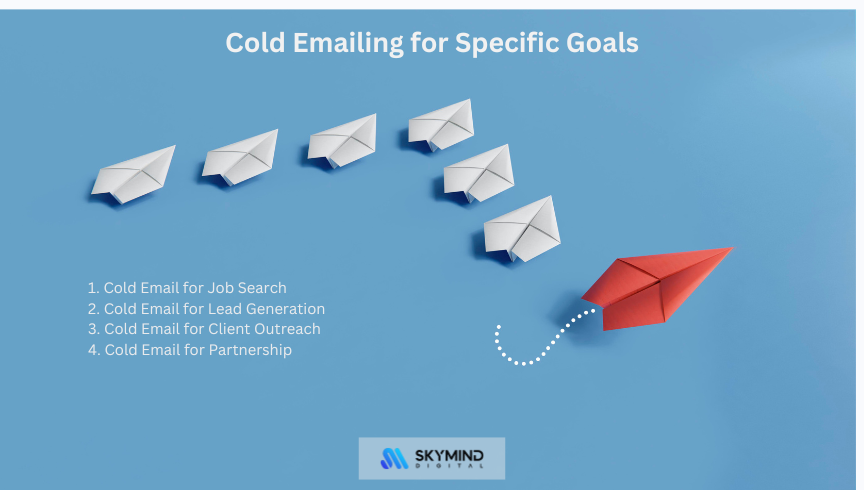 Cold Email for Job OpportunitiesCold emailing can be a powerful tool when searching for job opportunities. By reaching out directly to recruiters or hiring managers, you can bypass traditional job application systems and make a personal connection.Start by researching the recipient’s role and the company’s needs. Tailor your email to highlight how your skills align with their goals. Begin with a friendly introduction, mention why you’re interested in the company, and include a specific example of how you’ve excelled in a similar role.For example:
- Subject Line: “Excited about [Company’s] work in [specific field]”
- Opening: “Hi [Name], I admire [specific achievement of the company]. As a [your role], I’d love to contribute to your team.”
- Value Statement: “In my previous role at [Company], I improved [specific result]. I’d be thrilled to bring similar success to [Company Name].”
- Subject Line: “Quick idea to [specific benefit, e.g., boost ROI by 20%]”
- Opening: Reference the recipient’s business or industry challenges.
- Value Proposition: “We’ve helped [similar client] achieve [specific result], and I’d love to explore how we can do the same for you.”
- CTA: Suggest a call or demo to discuss further.
Cold Email Examples
Here are some detailed examples to inspire your cold email efforts:- Job Search Example
- Subject Line: “Excited to join [Company Name]’s team!”
- Email Body: “Hi [Name], I’m [Your Name], a [Your Profession] with a passion for [specific field]. I admire your work at [Company], especially your recent project on [specific example]. In my previous role, I achieved [specific result], and I’m confident I could contribute similarly to your team. Would you be open to a quick chat to discuss opportunities? Best regards, [Your Name]”
- Client Outreach Example
- Subject Line: “Helping [Company Name] improve [specific goal]”
- Email Body: “Hi [Name], I noticed [specific observation about their company]. At [Your Company], we specialize in helping businesses like yours achieve [specific benefit]. For example, we helped [similar company] increase [result]. Can we schedule a quick call to explore how we can support your goals? Best regards, [Your Name]”
- Partnership Example
- Subject Line: “Let’s collaborate on [specific project]”
- Email Body: “Hi [Name], I’m [Your Name] from [Your Company]. I recently came across [specific initiative] at your company and thought we might collaborate effectively. Our team has experience with [specific success], which aligns with your current needs. Would you be open to a conversation to explore this further? Best, [Your Name]”
How to Follow Up on Cold Emails
 Why Follow-Ups Are CrucialMany people won’t reply to your first email—not because they’re not interested, but because they’re busy. A well-timed follow-up can make all the difference.Psychologically, follow-ups show persistence and genuine interest. People are more likely to respond when they feel you value their time. Statistics back this up: Woodpecker’s research found that follow-up emails can boost response rates by up to 40%.Timing is key. Sending follow-ups 3-5 days after your initial email keeps your message fresh without overwhelming the recipient. Consistency and politeness are essential to stay on their radar.Writing Effective Follow-UpsHere’s how to write a follow-up email that gets noticed:
- Start by referencing your previous email:
- “Hi [Name], I wanted to follow up on the email I sent last week about [specific topic]. I hope it didn’t get buried in your inbox!”
- Reiterate your value proposition:
- Summarize how your solution addresses their needs or challenges. Be concise and direct.
- Provide new information or resources:
- Include a case study, testimonial, or helpful link to add value. For example: “Here’s a quick success story from a client who faced a similar challenge.”
- Keep your tone polite and professional:
- Avoid being pushy. Acknowledge their busy schedule: “I understand you’re likely busy, but I’d love to connect when you have a moment.”
- Subject Line: “Just following up on my earlier email”
- Body: “Hi [Name], I wanted to circle back regarding [specific topic]. We’ve helped [similar company] achieve [specific result], and I believe we could do something similar for you. Let me know if you’d like to discuss further—I’d be happy to schedule a call at your convenience. Best regards, [Your Name]”
- “Looking forward to your thoughts.”
- “Let me know if you’d like to explore this further.”
- “Best regards,” or “Sincerely,” followed by your full name.
Measuring the Success of Cold Emails
 Cold Email Success Metrics
To know if your cold email campaign is working, track these key metrics:
Cold Email Success Metrics
To know if your cold email campaign is working, track these key metrics:- Open Rate: This shows how many people opened your email. A good open rate typically ranges between 15-25%, but personalized subject lines can push this higher.
- Reply Rate: This indicates how many recipients responded to your email. The average reply rate for cold emails is around 8-10%, but following up and targeting the right audience can improve this.
- Conversion Rate: This measures how many recipients took your desired action, like booking a meeting or purchasing a product.
Cold Email vs. Cold Calling
 The debate between cold emailing and cold calling often depends on the industry and audience. Both have their place, but cold emailing is generally preferred for its scalability and convenience.Cold Emailing:
- Works well for reaching a large audience.
- Allows recipients to respond at their convenience.
- Less intrusive and better for industries like B2B SaaS or digital marketing, where prospects often prefer written communication.
- More personal and immediate but can feel intrusive.
- Often better for industries like real estate or high-ticket sales, where building rapport quickly is critical.
Advanced Cold Email Tactics
 How to Grab Attention in a Cold EmailGrabbing attention in a cold email is all about standing out in a crowded inbox. Here are a few proven techniques:
- Storytelling: Start your email with a short, compelling story that ties into your value proposition. For example, “When I worked with [similar company], they faced [specific challenges], and we helped them achieve [result].” Stories are engaging and make your email more memorable.
- Personalization: Mention something unique about the recipient, such as their recent project or company achievement. According to Yesware, personalized emails have a 20% higher response rate, so showing you’ve done your homework pays off.
- Emotional Appeal: Tap into emotions like curiosity, excitement, or concern. For example, frame your subject line as a question, such as “What if you could double your sales in 30 days?” or “Struggling with [specific issue]? Here’s a solution.”
- Add Value Right Away: Begin with a useful tip, insight, or resource related to the recipient’s industry. This positions you as a helpful expert rather than just another salesperson.
 Technology can make cold emailing smarter and more efficient. Tools like Google Workspace, CRM platforms, and email trackers simplify the process while providing valuable data.
- Google Workspace: Use Gmail’s scheduling feature to send emails at optimal times, and create templates for faster outreach. Google’s built-in analytics can track basic email performance, like open rates.
- CRM Platforms: Tools like HubSpot and Salesforce help manage contacts, track email engagement, and automate follow-ups. They also integrate with email marketing tools for seamless campaigns.
- Email Trackers: Tools like Yesware, Mailshake, and Mixmax notify you when recipients open your emails or click on links.
Frequently Asked Questions About Cold Emails
- Does cold emailing work to get clients?
- Is cold emailing legal?
- Use accurate sender information.
- Avoid misleading subject lines.
- Provide a clear opt-out option.
- What’s the typical response rate for cold emails?
- What is the best time to send a cold email?
- How do I maintain proper etiquette in cold emails?
- Address the recipient by name.
- Avoid being pushy.
- Focus on providing value.
- What is the effectiveness of cold email?
- How do you collect cold emails?
- Professional platforms: Use LinkedIn to identify decision-makers and often find their contact information.
- Company websites: Look for directories or “About Us” pages that list staff emails.
- Email finder tools: Tools like Hunter.io, Apollo, and Voila Norbert can help you find and verify email addresses.
- Networking events: Collect business cards or follow up with contacts you meet at events.
- How can I improve my cold email response rate?
- Personalize: Tailor each email to the recipient’s needs or interests.
- Focus on value: Clearly explain how you can solve their problem.
- Optimize timing: Send emails at times with higher engagement, such as Tuesdays or Thursdays, between 8-10 AM.
- Follow up: Sending 2-3 polite follow-ups can improve response rates by up to 40% (Woodpecker).
- What is the best email service for cold emails?
- Gmail: Easy to use and integrates with tools like Yesware.
- Outlook: Reliable for corporate outreach.
- Mailshake or Lemlist: Great for automation and tracking.
- How do I track cold emails?
- Open rates: See who opened your email.
- Click-through rates: Track links clicked within your email.
- Replies: Monitor response rates to measure engagement.